I’m never sure until I get a chance to glance at the photos.
Just these two tonight, more later this week I hope. I’ve got a very busy next two weeks, though, so who knows what will turn up when?
Sitting on the groundFast, low, pass
In that last one, he isn’t quite as close to the tree as he looks. That image won’t be the main one from that pass, because unfortunately the edge of the door frame is right through the pilot’s face. But I do like showing the helicopter in relation to the tree. Shot at 200mm on a 1.5x body, so 300mm-e, uncropped. And no, I did not shoot it in portrait format and turn it on its side, either.
When I was getting started in photography seriously, let’s call it the 1970s, I don’t think any lens wider than 21mm was at all commonly available for 35mm photographers. Oh, there were a couple of fisheyes, including Nikon’s monumental 6mm f/2.8; and their 15mm rectilinear came out in 1973, but I never heard of it then.
A few years have passed since then, and today UPS delivered to me a 12mm rectilinear wideangle. In fact, a 12-24mm zoom. For full-frame 35mm (film or digital).
12mm. I’m still appalled.
Here’s a fairly ordinary view of my room (which will be a bit surprising to people familiar with it).
12mm used for a fairly ordinary view.
And here’s a rather more interesting view from close to the same location.
12mm used from an unusual angle
I am a happy camper.
(Sigma 12-24mm f/4.5-5.6. Slow, bulgy, fragile, large. And remarkably cheap with a little shopping (I beat the B&H price on the day I ordered it by $200, which is unusual from any vaguely reputable dealer).)
What do photographers mean by “soft” light? And how do you produce it?
This is one of the most important things in photography, important everywhere from the sunlit outdoors to the studio. So pay attention.
Light: Science and Magic (Hunter & Fuqua), a textbook on lighting that I highly recommend, talks about this as early as chapter 2, using the term “contrast” (but talking about “soft” shadows produced by “low contrast” light). “For single light sources, the size of that source is the primary factor influencing its contrast.” (Amazon appears to have the third edition of the book, with a third author; mine appears to be the first edition; it was a present from Oleg Volk years ago when I asked if he’d run into any good textbooks on lighting.
There’s also the question “why should you care?” I’m mostly skipping that; sometimes you want soft light, sometimes hard, and it’s useful to know how to recognize and produce each. Deciding which you want is an artistic rather than technical decision, and I don’t write articles on artistic issues.
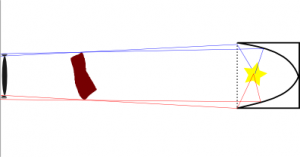
The softness of light is controlled by the apparent size of the light source as seen from the subject, and the distance from the subject to the background (where the shadow is cast).
Soft light—Critical Rays
The blue lines show the rays from both extremes and the center of the light source as they pass the top of the subject, and where they hit the backdrop. The red lines show the same for the bottom of the subject. The area completely behind the subject has the darkest shadow, with the shadow gradually brightening from there to the edge (both top and bottom).
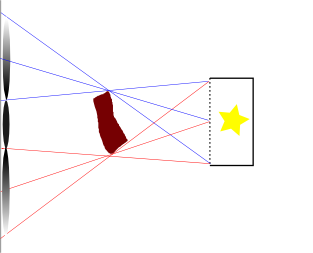
A couple of useful things come out of this immediately. You can make light softer simply by moving the light closer to the subject, or by moving the subject farther away from the background.
Closer and Softer—Critical Rays
Moving the light in has made the central, darkest, shadow smaller, and the zone in which the shadow gradually transitions from dark to light larger—a much softer shadow. (Moving the light closer also has other consequences—it makes the illumination on the subject brighter, and the difference between near and far parts of the subject stronger.)
Similarly, although I’m not going to draw it, moving the background farther away would make the shadows softer.
Wide-Angle Setting
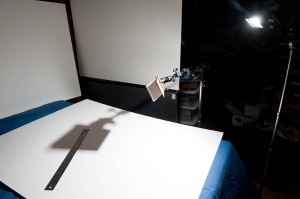
Now, let’s illustrate this with actual light. Here’s an actual fairly soft shadow, being cast by a small flash unit quite close to the subject, with the background nearly equally far away. As you can see, precisely defining the “edges” of this soft shadow is fairly hard.
So I have marked the shadow edges, partly by eye but largely by measured image brightness.
Wide-Angle Setting, Shadow Edges Marked
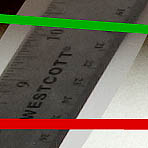
So, here’s a full-resolution crop of the part showing the shadow and the ruler. I’m going to say the gradient goes from from 19mm to 23mm, or 4mm.
Now, I’m wondering something. Does the flash head really produce light coming off in all directions (except backwards)? Or is the beam more focused? If the beam is enough more focused, rays from the top edge won’t stray far enough down to contribute as much to the wide shadow—essentially, an efficient reflector will make the flash head behave (in terms of softness) as smaller than it physically is.
Parallel beams leaving an efficient reflector
If the range of directions the beams leave the reflector is small enough, the light will be much harder than the physical size of the head suggests.
So, do my flashes behave this way? (The flash pictured is a Vivitar 285.)
"Wide" setting, diffusion material
Only one way to find out. Putting a couple of layers of “diffusion” material (like tissue paper) directly over the front of the flash will pretty much guarantee that the beams can leave in any forward direction. Let’s see if doing that makes the light any softer.
It’s obvious that there’s a lot more light emitted towards the sides now—the two vertical pieces of foamcore are much more brightly lit than in the first test, for example. And, visually, the shadow is clearly softer.
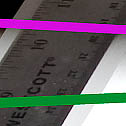
And, finally, here’s the close-up of the shadow over the ruler.
"Wide" setting, diffusion material, full resolution shadow on ruler
I make that 20mm to 25mm, or 5mm of gradient. Since it’s clearly visually softer than the un-diffused version, it’s nice that the measurement is in line with that.
Since the flash head is focused so well, does the zoom setting make a difference?
Flash at "tele" setting, no diffusion material.
Well, visually it seems to.
Flash at "tele" setting, no diffusion material, shadows markedFlash at "tele" setting, no diffusion material, full-res shadow on ruler
I read that as 19.5mm to 23mm, for 3.5mm, the narrowest shadow we’ve measured.
So, what have we learned here? We’ve confirmed some basic things about what makes light soft. We’ve shown that even a source as small as your flash can produce fairly soft light at close distances.
And we’ve shown that the physical size of the light source isn’t always the whole story. A light source can behave as smaller than its physical size for purposes of softness, and units based on small light sources plus reflectors are probably significantly more likely to exhibit this behavior (electronic flashes, in particular). This is why putting diffusion material over a light can make it softer, even though it isn’t making the light physically larger. It can’t, however, make the unit behave as if it were larger that its actual size.
I always wondered about putting diffusion material directly over a light source (across the front of the reflector for a studio light is the common example). It “obviously” couldn’t work, to my mind. Enough real photographers used it so I figured I must be wrong for some reason, but I think now I understand how it works. So that’s good.
Following the behind-the-scenes trend established last month when I went to Nashville, here’s Kyle shooting Pamela and the place she works. Well, the model of the place she works.


 (Hunter & Fuqua), a textbook on lighting that I highly recommend, talks about this as early as chapter 2, using the term “contrast” (but talking about “soft” shadows produced by “low contrast” light). “For single light sources, the size of that source is the primary factor influencing its contrast.” (Amazon appears to have the third edition of the book, with a third author; mine appears to be the first edition; it was a present from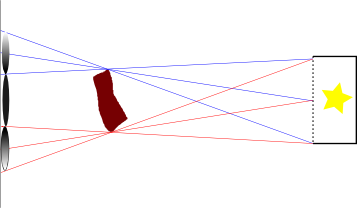


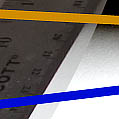 So, here’s a full-resolution crop of the part showing the shadow and the ruler. I’m going to say the gradient goes from from 19mm to 23mm, or 4mm.