Wait, did the Mac Win?

Just reading David Winer’s blog post saying it did.

In installations, that’s clearly not true. In business use, that’s clearly not true. In mindshare…it may well be true. And Apple is supreme in single-company computer sales…but are moving out of that business, it seems to me.

But I don’t want to talk about that.

What I want to talk about is his assertion that malware was a nightmare in the Windows world and in fact drove the Mac win.

That’s just not my experience. I’ve had Windows computers at work the whole time he discusses, and windows computers at home since I first installed Windows 1 (to develop an application). I’ve had full-time (broadband) connected computers at home since 1996. And in all that time, the only virus infection I’ve seen is one Word macro virus that I got in a document sent me by a fellow Minicon committee member. That’s it.

I’ve mostly run an anti-virus program — but it’s never stopped anything (it has, very very occasionally, suggested that something I downloaded from a site I considered dodgy probably contained something bad; but these were all cases where I had deliberately downloaded it, and manually scanned it to make sure because I felt there was cause to worry).

I don’t click things totally at random.

And I mostly don’t go to dodgy sites in the first place. I’m not often looking for illegal software or content, for example.

Malware has had essentially no impact on my user experience. It’s simply not a factor.

I have no idea why my experience is so completely different from Dave Winer’s.

But it’s a bit interesting.
Residential Network Oversubscription

People sometimes notice, and complain, that they can’t get the bandwidth they’re contracted for consistently.  We certainly do.

However, in all fairness to the providers, most residential connections aren’t used very heavily at all.  To offer competitive prices, the upstream connections need to be oversubscribed (at least with DSL, we really can get our full contracted bandwidth as far as the first router at Qwest, because that last mile of copper is not shared).

Our household has four adults who use the internet fairly heavily, including for Netflix streaming and such.  One of us works from home across the internet.

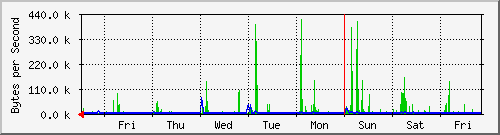
And here’s what our last week of usage looks like:

This is based on sampling of counters in the router via SNMP every five minutes; our actual peaks certainly go higher than that (the connection has an inbound rated speed of 7 megabits).  Also note that the chart is in bytes; that top line represents 3.52 megabits per second, a full half of the rated speed.

(And to those few of you who may be thinking this looks rather a lot like an MRTG chart, yes, it does, doesn’t it?)


A Major Transition

Sometime in the last decade or two we crossed over something that would have been viewed, in 1970 say, as a huge transition.

In fact, we hardly noticed as we crossed over it.

When I started developing software professionally, I wrote assembly language—actual machine instructions, with syntactic sugar to make them easier to read and remember, like mnemonics for op-codes, and the ability to assign names to memory locations.

From there, things progressed to compiled languages, which turned something like Fortran or Cobol or C commands into actual machine instructions.

There were also interpreted languages around—BASIC being the most famous one (well, or LISP, I guess).  They didn’t make your program into machine instructions at all; instead they just parsed and executed it directly.  This was slower, but easier to implement, and much easier to port to another environment.

Interpreted languages were widely viewed as toys (largely because most people had no idea how big some of the systems built in LISP were).

Well, sometime over the last couple of decades, I’m pretty sure we crossed the boundary, and most new lines of code written today are in interpreted languages—mostly Java and C#, though there’s plenty of Perl and Python and Ruby being written.

And it’s passed almost completely without remark.

(Closely based on a comment I made in rec.arts.sf.written)